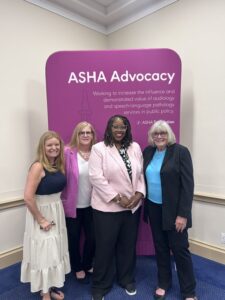
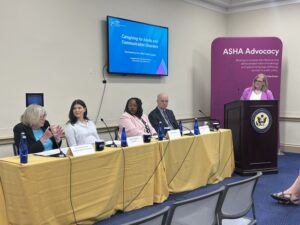
Earlier this month, the National Aphasia Association had the honor of representing the aphasia community during a federal advocacy event on Capitol Hill in Washington, D.C., held in recognition of National Speech-Language-Hearing Month.
Organized by ASHA (the American Speech-Language-Hearing Association) in partnership with the bipartisan Congressional Unified Voices Caucus, the day brought together speech-language pathologists, advocates, people living with communication disorders, and family members to educate lawmakers and congressional staff about the importance of lifelong access to speech-language services.
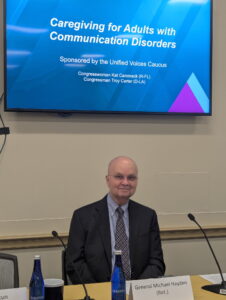
Representing the NAA was esteemed Board Member, General Michael Hayden and former Board Chair and Emeritus Board Member Darlene Williamson, who joined a panel discussion focused on the realities of living with aphasia and the ongoing need for support, education, and access to care.
The congressional briefing featured remarks from General Michael Hayden, former Director of the CIA, who spoke publicly about his experience with aphasia following stroke, alongside fellow advocate Erin Adelekun and speech-language pathologist Anna Dickstein of MedStar National Rehabilitation Hospital.
Together, panelists emphasized several key priorities:
- The chronic nature of aphasia and the need for continued support beyond the acute phase of recovery
- The importance of access to speech-language pathology services
- The need for fair reimbursement for treatment
- The value of virtual services and telepractice
- The critical role education, resources, and community organizations play for families navigating aphasia
In addition to the briefing, advocates met with congressional offices to discuss policies affecting access to care and support services for people with communication disorders.
“We had the opportunity to help legislators better understand aphasia and the daily realities faced by individuals and families living with it,” said Williamson. “It was encouraging to see genuine interest and bipartisan support for these issues.”
The NAA is grateful to ASHA Advocacy for including aphasia representation in these conversations and for helping elevate the voices of people impacted by communication disorders nationwide.
Advocacy matters. Every conversation that increases awareness of aphasia helps move us toward a future with greater understanding, access, and support for the millions of people affected.
Special thanks to General Hayden and Darlene Williamson for representing the NAA and the aphasia community with compassion, professionalism, and dedication.