
Leaving the hospital can bring many questions.
People with aphasia and their families may wonder:
- What happens next?
- Where will I go?
- What help will I need?
- Who can answer my questions?
- How can I continue my recovery?
Clear information and good communication matter.
The National Aphasia Association (NAA) developed an Aphasia Discharge Checklist to help people with aphasia, families, and healthcare teams plan for leaving the hospital.
The checklist helps people ask questions, share information, and prepare for the next steps in their care.
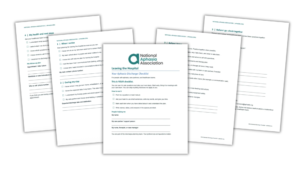
The checklist can be used throughout your hospital stay.
You can use it to:
- Keep track of important information.
- Write down questions.
- Talk with your healthcare team.
- Plan for leaving the hospital.
How to Use the Checklist:
- Start early. You do not need to wait until the day you leave the hospital.
- Use it with your care team. Talk with your doctor, nurse, therapist, or case manager.
- Include people who support you. Family members, friends, and other care partners can help with planning.
- Write things down. Keep important names, phone numbers, appointments, and questions in one place.
- Make it work for you. Not every item will apply to every person.
 For Hospitals and Healthcare Professionals
The NAA Aphasia Discharge Checklist is a resource that hospitals and healthcare systems can adapt for their own discharge planning processes.
The goal is to help people with aphasia and their care partners receive clear information and participate in decisions about their care.
The checklist is organized in chronological order, beginning at admission and continuing through discharge.
It includes:
- Aphasia-specific questions.
- Space for notes and care partner input.
- Resources for people living with aphasia.
- Opportunities for communication between patients, families, and healthcare professionals.
Interested in using the checklist at your facility?
We encourage hospitals, rehabilitation centers, case managers, speech-language pathologists, and other healthcare professionals to explore this resource.
Please include people with aphasia and care partners when adapting it for your setting.
Contact answers@aphasia.org to learn more and to provide essential feedback.
How the Checklist Was Developed:
The NAA Aphasia Discharge Checklist grew from an effort led by former ASHA President, Paul Rao, PhD, former ASHA President during his service on the NAA Board of Directors. The project brought together a 12-member task force that included people with aphasia, care partners, speech-language pathologists, physicians, and case managers.
The group worked to develop a practical, aphasia-friendly resource that could help address information gaps during hospital discharge. The checklist was reviewed with professionals and people affected by aphasia, refined, and approved by the NAA Board. The work was also inspired by the Australian Aphasia Association’s LEAVING Discharge Planning Checklist, developed to support people with aphasia during the transition from hospital care during the global COVID-19 pandemic.
View the Australian Aphasia Association’s LEAVING Checklist
Research and Resources:
Avent, J., Glista, S., Wallace, S., Jackson, J., Nishioka, J., & Yip, W. (2005). Family information needs about aphasia. Aphasiology, 19(3–5), 365–375. Read article
Hersh, D. (2009). How do people with aphasia view their discharge from therapy? Aphasiology, 23(3), 331–350. Read article
Hersh, D., & Armstrong, E. (2021). Information, communication, advocacy, and complaint: How the spouse of a man with aphasia managed his discharge from hospital. Aphasiology, 35(8), 1067–1083. Read article
Hinckley, J. J., Hasselkus, A., & Ganzfried, E. (2013). What people living with aphasia think about the availability of aphasia resources. American Journal of Speech-Language Pathology, 22(2), S310–S317. Read article
Worrall, L., Sherratt, S., Rogers, P., Howe, T., Hersh, D., Ferguson, A., & Davidson, B. (2011). What people with aphasia want: Their goals according to the ICF. Aphasiology, 25(3), 309–322. Read article
Hersh, D., & Australian Aphasia Association. AAA Discharge Planning LEAVING Checklist for People with Aphasia. View checklist
Help Us Improve Discharge Planning
Are you a person with aphasia, a care partner, or a healthcare professional?
We would like to hear about your experiences with hospital discharge.
Are you using the checklist? What has been helpful? What could be better?
Email answers@aphasia.org.
This checklist supports discharge planning conversations. It does not replace medical advice or instructions from your healthcare team.