
For many people, it can be hard to imagine what it would be like to have aphasia. You may know that aphasia affects communication: speaking, understanding, reading, and/or writing. But knowing the definition is different from understanding the everyday challenges that people with aphasia may experience.
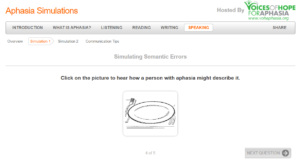
One way to build that understanding is through interactive aphasia simulations. No simulation can fully recreate what it is like to live with aphasia: every person’s experience is unique, and no activity can capture the emotional, social, and personal impact of living with aphasia. However, simulations can help us better understand some of the communication challenges that people with aphasia may face.
About the Simulations
In 2000, NAA Board Chair Dr. Jackie Hinckley published the book “What is it like to have trouble communicating? A series of simulation activities to educate family, friends, and caregivers.” She then collaborated with Keen Research to develop online, interactive aphasia simulations, which were adapted for use on the Voices of Hope for Aphasia website. Now, these longstanding simulations have been translated into Spanish by Aphasia for Latin America (Afasia por Latinoamérica).
Try the Aphasia Simulations
The Aphasia Simulations are available free online. They include the following sections:
- Aphasia education
- Interactive simulations of listening, reading, writing, and speaking
- Tips for supporting the verbal and written communication of people with aphasia
Who Could Benefit from Trying These Simulations?
These activities can be valuable for anyone who wants to better understand aphasia, including:
- Family members, friends, and other care partners
- Healthcare providers
- Researchers
- Students
- Community organizations
- Employers and volunteers
- Anyone interested in learning more about aphasia!
For instance, family members often say, “I didn’t understand it might be like that!” For students, the simulations bring textbook knowledge to life.
What You May Learn
As you complete the simulations, you may gain insight into why:
- Words don’t always come out as expected.
- Reading may require extra effort.
- Understanding spoken language can be challenging.
- Communication can be mentally tiring.
- Patience and supportive communication strategies make a difference.
These experiences can help foster greater understanding and more effective communication with people living with aphasia.
Continue Learning About Aphasia
The National Aphasia Association is the nation’s nonprofit resource for people with aphasia, families, professionals, providers, researchers, and advocates. To learn more about aphasia, keep exploring our website, aphasia.org, which includes resources on:
- What aphasia is
- Tips for communicating with someone with aphasia
- Aphasia events and programs
- Finding resources and support
- Finding providers near you
- How to increase aphasia awareness
The better we understand aphasia, the better we can support the millions of people and families whose lives are affected by it.
¿Como se siente tener afasia?
Contribuido por Andrea Herrera Suescun.
Prueba estas simulaciones de Afasia
Ahora están disponibles en español e inglés.
Para muchas personas es difícil imaginar cómo se siente tener afasia.
La afasia puede afectar la comunicación. Por ejemplo, puede ser difícil:
- Hablar.
- Entender lo que otras personas dicen.
- Leer.
- Escribir.
Pero conocer esta definición no es lo mismo que comprender cómo se siente vivir con afasia todos los días.
Una forma de comprender mejor la afasia
Estas simulaciones permiten experimentar algunas dificultades de comunicación que puede tener una persona con afasia.
Importante
Una simulación no puede mostrar exactamente cómo se siente vivir con afasia.
Cada persona con afasia es diferente.
Además, una simulación no puede representar todos los efectos emocionales, sociales y personales de la afasia.
Sin embargo, puede ayudarnos a comprender mejor algunas dificultades de comunicación.
¿De dónde vienen estas simulaciones?
En el año 2000, la Dra. Jackie Hinckley publicó un libro con actividades para ayudar a familiares, amigos y cuidadores a comprender las dificultades de comunicación.
Después, trabajó con Keen Research para crear simulaciones interactivas en línea.
Estas simulaciones fueron adaptadas para el sitio web de “Voices of Hope for Aphasia”.
Ahora también están disponibles en español gracias a Afasia por Latinoamérica.
Prueba las simulaciones
Las simulaciones son gratuitas y están disponibles en Internet.
Encontrarás:
- Información sobre la afasia.
- Simulaciones para experimentar dificultades al escuchar.
- Simulaciones de lectura.
- Simulaciones de escritura.
- Simulaciones del habla.
- Consejos para comunicarse mejor con personas con afasia.
Simulaciones en inglés:
https://www.vohaphasia.org/simulation/
Simulaciones en español:
https://simulacion-afasia.base44.app/Introduccion
¿Para quién pueden ser estas simulaciones?
Pueden ser útiles para:
- Familiares.
- Amigos.
- Cuidadores.
- Profesionales de la salud.
- Investigadores.
- Estudiantes.
- Organizaciones de la comunidad.
- Empleadores y voluntarios.
- Cualquier persona que quiera comprender mejor la afasia.
Algunas personas dicen después de realizar las actividades: “No sabía que podía sentirse así.”
Para los estudiantes, las simulaciones también ayudan a comprender mejor lo que han aprendido sobre la afasia.
¿Qué puedes aprender?
Las simulaciones pueden ayudarte a comprender por qué una persona con afasia:
- Puede saber lo que quiere decir, pero tener dificultad para encontrar las palabras.
- Puede necesitar más tiempo para leer.
- Puede tener dificultad para entender lo que escucha.
- Puede cansarse al comunicarse.
- Puede necesitar más tiempo y apoyo para comunicarse.
La paciencia y una comunicación adecuada pueden hacer una gran diferencia.
Continúa aprendiendo sobre la Afasia
La “National Aphasia Association” ofrece información y recursos para:
- Personas con afasia.
- Familias y cuidadores.
- Profesionales.
- Investigadores.
- Personas que trabajan por una mayor comprensión de la afasia.
En aphasia.org puede encontrar información sobre:
- Qué es la afasia.
- Cómo comunicarse mejor con una persona con afasia.
- Eventos y programas.
- Recursos y apoyo.
- Profesionales que trabajan con personas con afasia.
- Cómo ayudar a que más personas conozcan y comprendan la afasia.
Comprender mejor la afasia nos ayuda a comunicarnos mejor y a apoyar a las personas con afasia y a sus familias.