
Contributed by Megan Sutton, a speech-language pathologist, member of the NAA’s Professional Advisory Council, and co-founder of Tactus Therapy.
I recently asked people with aphasia and their loved ones: What is the biggest challenge you face when practicing at home?
Over 150 people replied!
Here is what they shared, and what technology can do to help.
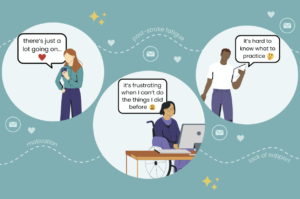
1. Getting started is the hardest part.
This was the #1 answer by far. Almost half of the respondents said something like, “I want to practice, but…”
Planning, remembering, getting started, and staying motivated can all be harder after a stroke or brain injury.
How technology can help:
- Use digital calendars or alarms to schedule your practice time.
- Use a program with a built-in plan, so you don’t have to decide what to work on next.
- Try to hit daily targets, so it’s clear when practice is finished.
2. Help can be hard to find.
Long waitlists. Long drives. Insurance limitations. Therapy that ends too soon.
A lot of people told us the support they had at the beginning didn’t last. Therapy ended, or dropped to once a month, or was never available in the first place.
Plus, energy levels don’t follow an appointment schedule! It can be tricky when speech therapy is only available on specific days and times.
How technology can help:
- Teletherapy can be a good option when logistics make in-person visits difficult.
- Online support groups can help you find a community that understands aphasia.
- Home exercise programs or apps can add more hours of practice per week, and can be done any time from the comfort of your home.
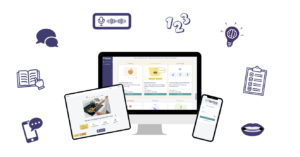
3. It’s hard when family becomes the therapist.
Nobody wants to be a “patient” or an “examiner” all the time.
Sometimes you just want to keep being a spouse, partner, daughter, son, mom or dad.
It can help when practice comes from outside the family.
How technology can help:
- Use apps or home programs that are accessible and aphasia-friendly to promote independence.
- Use programs that tell you if the answer is correct, with built-in hints and feedback.
- Let technology decide what exercise comes next and adjust difficulty levels based on performance.
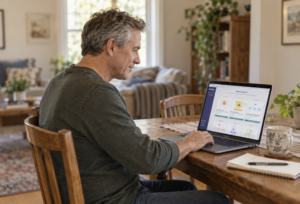
4. Practice is really about life.
Home exercises are really just small steps toward the things that matter.
Talking to your grandkids, ordering at a restaurant, making phone calls, following a conversation at the dinner table, or going back to work.
How technology can help:
- Use exercise programs that practice real-life communication skills like reading a menu, listening to voicemails, or writing text messages.
- Use technology to get lots of repetition, then practice those same skills again in real life.
- When you feel comfortable, use everyday tasks on your phone or computer to practice. Real text messages, voice notes, reminders, and video calls are exactly what you’re working toward!
Things to consider for aphasia home exercise programs and apps
Before choosing a home program, here are a few things worth checking:
- Is it straightforward and easy to use?
- Are there built-in hints and feedback for independent practice?
- Does difficulty increase over time? (Or decrease if exercises are too challenging?)
- Can you see whether it is working? Is there a way to view progress?
- Is it easy to return to practice after a week away?
- Does it connect to real-life communication goals?
Final Thoughts
Home practice is hard, but technology can help.
Technology is not a replacement for traditional speech therapy. However – it can provide many more hours of practice, at the right level, at home, and at your own pace.
In one study, 278 people with chronic aphasia used word-finding software at home for six months. They got significantly better at the words they practiced, and they were still better when researchers checked back six months later. (Palmer et al., 2019).
Recovery doesn’t stop after the first few months. People make real progress years after a stroke or brain injury. If you’re starting now, you’re not starting too late.
References and Resources
- Article: Palmer, R., Dimairo, M., Cooper, C., Enderby, P., Brady, M., Bowen, A., Latimer, N., Julious, S., Cross, E., Alshreef, A., Harrison, M., Bradley, E., Witts, H., & Chater, T. (2019). Self-managed, computerised speech and language therapy for patients with chronic aphasia post-stroke compared with usual care or attention control (Big CACTUS): A multicentre, single-blinded, randomised controlled trial. The Lancet Neurology, 18(9), 821–833. https://doi.org/10.1016/S1474-4422(19)30192-9
- Tactus Virtual Rehab Center at Home
- Tactus Virtual Rehab Center
- Tactus Therapy Apps
- Free Downloads from Tactus
- NAA Tools & Technology Resource Library
- Aphasia Software Finder