Contributed by NAA Board Member Angie Cauthorn, a two-time stroke survivor and person with aphasia. She hosts Brain Friends: The Podcast and serves as President and Co-Founder of the Aphasia Resource Collaboration Hub (ARCH).
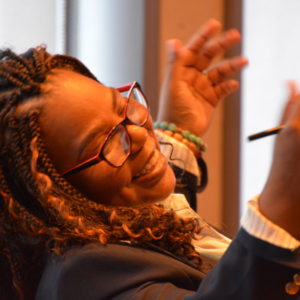 Hi, I’m Angie Cauthorn. I’m a two-time stroke survivor. Both strokes happened the same night. I live with aphasia.
Imagine a world where a simple conversation feels like climbing a mountain. That is daily life for over 2 million Americans living with aphasia, a language disorder most often caused by stroke. It can take away the ability to speak, to understand, to read, to write. But here is the good news: neuroplasticity is real. The brain can rewire. There is just one catch. Good habits are what make the rewiring hold.
Before my strokes, I was an avid reader. In my mid-twenties, I picked up Stephen Covey’s The 7 Habits of Highly Effective People. I had no idea that book would become a framework for my recovery. In the middle of relearning language, and in the middle of depression, I found myself reaching for those habits again, this time not as career advice but as a way back to myself.
Habit One: Be Proactive.
A stroke can disrupt your life, but you still choose your response. Aphasia was once treated as fixed, permanent, unchangeable. That thinking is being rewritten. New therapies are emerging, built on the brain’s own capacity to reroute itself. This is not a cure. It is a revolution.
Habit Two: Begin with the End in Mind.
Every survivor carries a picture of what recovery looks like. Maybe it is ordering your favorite coffee again. Maybe it is sharing that private joke with a childhood friend. Therapy is the bridge to that picture, and research-based approaches are the strongest bridge material there is. These therapies are built by university researchers, tested with real people, and constantly refined. They gave me the best chance at reaching my own communication goals.
Habit Three: Put First Things First.
Therapy is not easy, but it deserves top billing in your recovery. Think of it as an investment, not in your speech alone, but in your reconnection with the world. Talk with your therapist about incorporating the latest approaches into your plan. Recovery is a team effort: you, your therapist, and the researchers pushing the field forward.
You are not alone. Millions are walking this same road.
Habit Four: Think Win-Win, and Be Interdependent.
Lean on your support system. It is easy to turn inward, to grow comfortable with being uncomfortable, to stop reaching out. Resist that pull.
Habit Five: Seek First to Understand, Then to Be Understood.
Communicate your needs and your frustrations, even when the words are hard to find. And remember that your family and friends are hurting too. This happened to them as well, just in a different way.
Habit Six: Synergize.
Combine traditional therapy with the latest research for the best results. Every researcher I know has been a speech-language pathologist for twenty-plus years, and many have specialties in other areas of medicine too. That mix is what moves this field forward.
Habit Seven: Sharpen the Saw.
Take care of yourself, physically and emotionally. It fuels your recovery. Sleep. Rest. Take naps. Give yourself grace.
Research is the wind in our sails. It carries us toward a future where aphasia does not define us, where we define our recovery, one habit, one word, one day at a time.